In Aqueous Sites and Other Drawings, Mackey uses photography and video to exploit the similarities and differences between analogue and digital mark making using paper, water, light and the human form.
This research considers the visual possibilities of what was originally a series of en plein air drawings, manipulating the original works through folding, wrapping and immersing drawings within contained spaces which often feature water.
Presented as groups of still and moving images, the artist harnesses the use of underwater settings, strong lighting, a narrow depth of field and often enlarged representations of the scale of the human body to create more abstracted depictions of the original sites. It is Mackey’s intent that the images no longer seem to be of a specific place, nor are the human forms depicted as identifiable people – but more as a series of drawn marks.
Aqueous Sites and Other Drawings moves Mackey’s research forward from recent works that explored how bodies operated as “artefacts of leisure”often in water-based environments to the broader question of how we best capture the calligraphic potentials of how water moves and draws within a space. This invites the audience to consider how the human body adds to these cartographic gestures within the ongoing traditions of how the human form is represented in relation to landscape/place.

Aqueous Drawings 1 (2024) Video – 9mins 30 secs Finalist in the Sunshine Coast National Art Prize 2024.
Click here to see the full video work.

Aqueous Site 3 (2024) Digital photographic print on Hahnemühle photo rag paper. Finalist in the Mullins Conceptual Photography Prize Muswellbrook Regional Arts Centre 2024
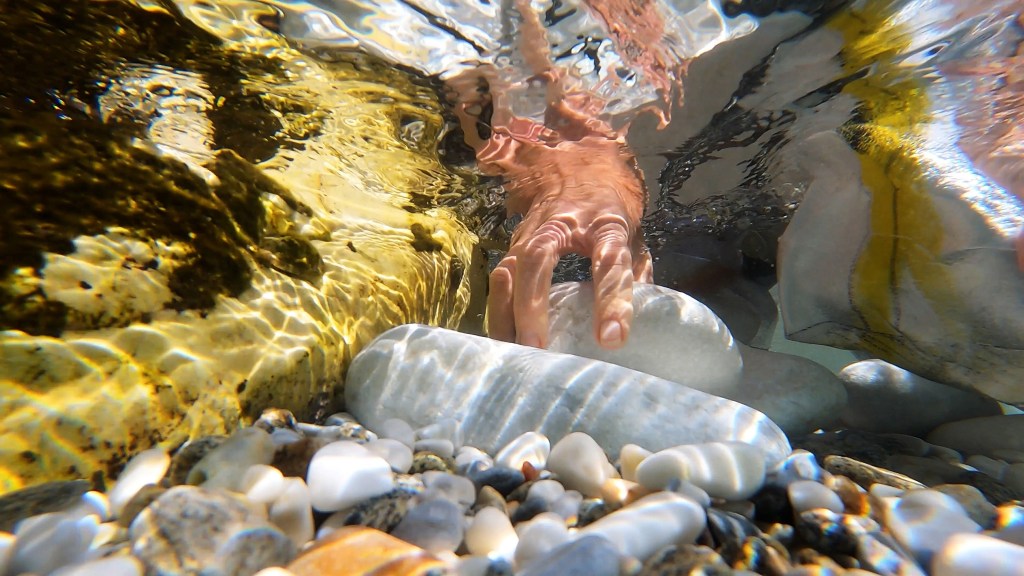
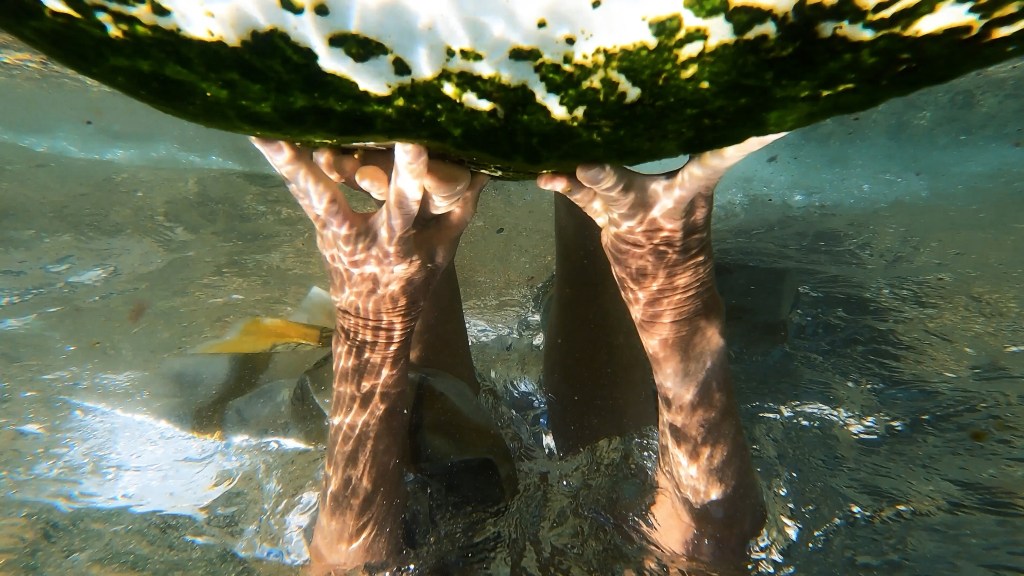
Holding Water – Kavala Sequence (2025) Video Stills
This research was extended through the Eutopia Art Residency in Kavala, (Northern Greece)in September 2025 where the artist worked with drawings of and with granitoid rocks from the beaches – forms of crystalline that are fragmented and capable of holding water. She noted in detail the incredible variation in the colours of marble, both contemporary and historical.
The fragmentation of sculptural bodies in the archaeological museums also saw Mackey respond by making works that purposely utilised only arms and legs as representations of the human form in relation to the aqueous and geological. By experimenting with inverted images above and below the water line – she was able to generate new responses to both the actual site and its many histories.
 Kathy Mackey